Does it always have to be hard?

I've been telling myself a story and it goes like this: "Everything has to be hard.  Growth must come through bumps and bruises.  If it wasn’t difficult, I didn't try hard enough.”  By making this my belief, I was demanding it be my destiny.  Like most limiting beliefs, I had no idea it was even within me.

My first big ‘aha moment’ came while recording T.H.E. Celebration Academy.  After recording half the lessons, I was feeling like I did something wrong.  That I somehow didn’t give it my all.  Then it hit me.  I was feeling that way because the process was so easy and natural.   I had anticipated it the road to be rocky and when it was smooth I felt anxious.  

Have you ever felt that way? That because it wasn’t hard or painful it wasn’t done right.  It took me 29 years to realize I held this belief.  

One key to self-awareness is recognizing our repetitive thoughts.  Receptive thoughts that diminish our self-worth become limiting beliefs.  These are the beliefs that tell us not to try, to give up before we start, and that we are not worthy.  They are the thoughts and beliefs that plague us with insecurity and doubt.   I say boooo to them!

So what can we do?  First thing I did was to get a big ole’ flashlight.  Our limiting beliefs like to hide in the shadows.  Once you shine a light on them, they are no longer able to influence us in stealth.  Asking questions is the brightest light you can shine on a thought.

Here’s the process I used:

1.  Name it and say, “I see you limiting belief!” 

2.  Get curious and ask questions.

3. Envision a different possibility. 

Here’s an example:

A few days ago I came home from work feeling like I hadn’t given the day my all.  I got curious about my emotions, and asked myself questions.  In response, I started listing off all that I did that day.  To my my amazement, I had actually accomplished a lot! So I asked,  Why am I feeling like I somehow failed? Then it hit me, I am operating under my limiting belief that if it wasn’t hard, it wasn’t done right.  

Since the day wasn’t filled with stress and fires, I could only conclude that I did something wrong.  Naming that instantly gave me the choice, do I really believe that? Is that the only way I can be successful?   I then began to envision a different possibility.  That I can feel fulfillment and accomplishment without the presence of turbulence.

I know that a diamond is created under pressure.  That muscle is built through resistance.  That with difficulty comes ease.  These mindsets propel me through each challenge that comes my way.  However, I had began to believe that success could ONLY come through adversity.  

Rather than being empowering, I had transformed my philosophy into something that was holding me back.  I now have a more balanced belief system. I have a healthy relationship with challenge. While at the same time, I know that I can also grow through happiness, laughter, love, and ease. 

I’d love to hear your perspective and thoughts.  What does this bring up for you?  Do you see this showing up in your life?

Let me know if you have any questions.  

Peace and Blessings!

This is also available is an iTunes podcast episode!

A Muslim's reflection on conversations with Trump Supporters.

I keep getting asked: why are you Muslim when Islam hates women and is intolerant of other religions?  It’s a question I’m asked quite often by Trump Supporters.  It baffles me, hearing a Trump supporter ask, "how can you support a movement that demonizes other religions and treats women so horrible?” Because that is my question for them, How can you support a person and a movement that is bigoted towards other religions and sexist towards women?

When I step back and reflect upon it, it blows my mind.  We are both looking at each other asking the same exact question.

I clearly feel like I am right and that they are wrong. I believe people are misinformed about my religion. That they take out of context quotes, or misquotes, or misinformation and form an inaccurate picture about my religion. I feel that people take all of this wrong information and use it to stereotype my entire religion.

And then I hear the same feelings echoed back to me from the other person. They feel that my opinion on Trump comes from out of context quotes, or misinformation, and etc. They share with me that yes, there are extremists who support Trump, but that the everyday Trump supporter is a good person.

The mirror reflection of the conversation just stuns me.

I understand the difference of where we stand in regards to privilege and power. I'm defending my religious identity rather than my political opinion.  Trump is the president of the U.S. and has all the power that goes with that.  Whereas, Islam, in the context of the U.S., does not have systemic power or privilege.

As an individual, I feel massive amounts of fear because of Islamophobia.  The question is heavy on my mind, what will it mean to be a Muslim in a Trump nation? Already I have seen the consequences: People having their hijabs torn off, Muslims being yelled at and attacked in the streets, a man was planning a massive shooting on the Mosque/Masjid I attend, and threats of forced registration.  I feel this fear everyday.  And it must be said, I am an extremely privileged Muslim.  I walk around everyday and people have no idea I’m Muslim.  I can’t even begin to imagine the fraction of what someone feels who is visibly assumed to be Muslim.

I’ve shared this with many Trump supporters over the past few weeks.  And then they tell me, well that’s the way they feel about Islam.  That they live in constant fear of terrorist attacks, or their rights being taken away by sharia law, or of ISIS, and that its unsafe to be a Christian in this world.

I tell them that’s crazy.  All of those things are exaggerated and fear mongered by the media and politicians.  ISIS has nothing to do with Islam.  And then they tell me that I’m crazy.  That I’ve been brainwashed by the media and fear mongers and that all the things I’ve heard about Trump are lies.

This leaves me reflecting, what next? Where do we go from here? What is an effective way forward? When we both are staring at each other feeling the exact same way: "I’m right, you’re wrong. My people suffer because you’re people are crazy.  I am justified in my feelings and correct in my facts."

My intention of this post is to share these thoughts that have been bouncing in my head and then listen. And so I’ll conclude with, what are your thoughts?  What does this mirror conversation mean?  What comes next?

I was a white man with dread locks...

For 9 years I was a white man with dread locks.  To clarify, I still am I white man. But I no longer have the dread locks.  For 7 of those nine years my self-awareness of what that meant was limited to my immediate circle.  Excluding my Dad, the general consensus was: Tom your hair is awesome.  And with no other feedback around, I kept moving confidently in the direction of Tom Earl with dread locks.  And so they grew all the way down to my waist.

Flash-forward to the year 2013, 7 years into it, I learned that it’s not all about me.   But this post isn’t the story of why I cut my hair. This is about a time I was deeply invested and committed to a belief and came to realize I was wrong.  As right as it felt, I was in fact participating in institutional racism.

If you can imagine, this wasn’t just an abstract belief.  I had invested years of time and energy into it.  It was a part of my identity.

And what shifted it all, what really made me look in the mirror and ask myself is it worth it, was one question.

“Do my feelings matter more than the lives of those my actions impact?”

I asked myself - ‘are my feelings more important than someone else’s life?’ - over and over and over and over again.  I had every excuse in the book to answer it in a way that didn’t equate to me having to change.

Eventually, unless I was to remain in denial, I had to recognize: Yes, I was putting my feelings over an entire group of people.  So, I cut it.  Like I said, long story short.

Why bring this up? I share this because I keep asking myself this question regarding this year’s election.

I hear Trump voters saying they aren’t racist or sexist or homophobic.  They voted Trump because they felt he was the right choice.  And I ask, do your feelings matter more than the lives of People of Color, or people who are LGBTQ, or women, or Muslims or Jews?

Folks keep telling me, Hillary controls the media and they brainwashed you into thinking Trump spreads hatred and bigotry.  My friend, that sentence right there should be an insight into how insulated one’s circle of friends are. 

I don’t hear from the media about Trump’s actions, I hear from people I know. Real life people, who have been assaulted, intimidated or screamed at by someone who concluded with, “And now that Trumps here, we are kicking you out of our country.”  That’s not from the “liberal news.”  That’s from real life.

Don’t get me wrong.  I’m not saying you should have voted Hillary.  I am asking myself this same question about my vote for Hillary.  Do my feelings matter more than the lives of those affected by war and other actions of Hillary’s?

And that is the real question I’d love to be discussing.  How was it that neither presidential candidate was someone we could say was truly anti-oppression and anti-discrimination?  

This is bigger than just a presidential election or politics.  It is about how many people are desperately trying to hold on to what they feel is right and true.  But what does it mean when one’s truth creates a world that is unsafe for others to be in?  When one’s beliefs erase another person’s identity?  When my feelings of what is right overlooks the consequence of my actions?  

It was my hope that I might offer a tool of reflection for self-awareness. This question has now become my guide, “Where in my life am I putting my feelings over others?”   

As someone who has privilege in almost every aspect of my identity, rarely, am I ever able to answer that accurately by myself.   Which is why I value dialogue much more than mono.  And so with that, I’m going to switch to listening.

Peace and Blessings.    

Remember when.....

Remember in 2014 when Mo Asumang, a Black Women, interviewed the KKK and they said, "I am not racist. No one in the KKK is a racist." The shaking of my head is similar to my disbelief when I hear Trump voters say they race, gender, and bigotry had nothing to do with their vote.


I hear you, and have listened to many, many Trump voters say they didn't vote because of those 'topics.' Or that Trump was just saying those things to get elected and the real Trump isn't like that.


But what it comes down to is that it was still a vote for someone who used their platform and leadership to spread bigotry, scapegoating and violence as a solution.


So I hear you saying it wasn’t racism to vote for Trump, and yet the contradiction of values still stands.   Trump is a racist, a bigot, a sexist, an Islamophobe.  So how can a vote for him not be supporting those values?  How is it possible to select the aspects of what we want to support in someone, when we are voting for the whole person?


But the votes over.  It’s done.  If we had a time machine then I’d keep going back and forth about how the vote went down.  So instead I move forward with you.  And we will ultimately get the answer to the riddle of: could someone who voted for trump still be a person who believes everyone deserves the right to respect and dignity?

And we will find out that answer by your actions.  If (when) Trump continues to say statements or puts into plan actions that value one life above another, will we see you on social media, in conversations with your friends, and in the streets saying, “This was not why I voted for you! How dare you say those things!  I will defend everyone’s right to respect and dignity!”  If one of your Trump voting friends says, “Can’t wait till he gets rid of (insert group of people they hate), will you call them out and say, “I voted for Trump and I will not stand for that bigotry.”

Because then that’s using one’s privilege and power to confront and challenge bigotry.  Because a Trump supporter will hear it differently from another Trump supporter.  Can’t say back to you, “oh well you’re just a damn liberal.”  No my friend.  That’s Trump on Trump supporter saying I won’t stand for your violence.

If not.  If it’s just radio silence.  If it’s just being a bystander.  Or a perpetrator.  Well then we loop back to how I started this post, it will be obvious cooperation with bigotry and violence all while denying one’s participation in it. 

And Oh Lord, trust me.  Just because I didn’t vote for Trump doesn’t mean I’m off the hook.  Or that I’m automatically one of the “good ones.”  I’m also only as good as my last at bat.  I am still responsible to use my influence and privilege to be an upsatnder and to be accountable and take personal responsibility.  So please don’t read this as me on my high horse. 

More like me being like, “I hear you say that you don’t support bigotry, and now I’d love to see what that looks like in words and actions. And if you see me slipping.  If you see me living my life in a way that doesn’t align with my values, please let me know too.”

Peace and blessings. 

A (white passing) Muslims Reflections Post-Election Day

I woke up today completely committed to creating a world of equity and inclusion.  It pains me to my core to see the election results.  But sadly, I’m also telling myself, “well – what was once the hidden opinion of many is now explicit.” 

I’m going to be honest, I keep fighting down the fear and anxiety that I feel in my stomach, my heart, and pretty much all over. Fear for myself as a (white passing) Muslim and for all those the Trump nation targeted and fear mongered in their campaign. 

And then another part of me keeps saying things like, “Allah is with those whose hearts are torn.” And “Don’t let them grind you down.” And “They gave us lemons and we made lemonade.”

And I think of the thousands and thousands of young people I’ve worked with and how passionate and dedicated they are to being inclusive leaders.   And how change work is a long game, and our future looks bright in that regard.

Whenever I feel myself losing hope, I go back to what I learned from one of the greatest leaders I know – Diane Burbie.  And how she taught me that in moments like this we have to get grounded in our belief in people’s ability to change. 

And so for me, I am renewing that belief.  I believe in the process of diverse groups of people coming together to dialogue and relationship build.  I have seen the process transform someone from being a neo-nazi to an activist for peace.  I have seen students who were once homophobic have a transformation and become active leaders in their Gay Straight Alliance. 

I think of all those who at one time wanted to kill Prophet Muhammad and who later become one of his greatest followers.  I think of Paul on the road to Damascus.  How he was at one time one of the most feared tyrants, becoming an advocate for peace. 

And many, many more big and small examples come to mind.

All that to say, in moments like right now, when despair is right at my front door, I’m getting really grounded in my belief that transformation is possible.  And I’m renewing my commitments.

I commit first and foremost to the journey of self-awareness and personal responsibility.  Of uprooting my own biases and learned behaviors and striving to be inclusive in my beliefs and actions.  Secondly I commit to using my privilege, leadership and influence to challenge and confront bias and bigotry, and work towards making the world a place of inclusion and equity.

In the spirit of complete honesty, writing for me is cathartic.  It is how I process.  And in large part that is what this is.  I appreciate you allowing me the space to do so in a public way.   I know that it can be helpful seeing what folks in our community are thinking right now.  And so I decided to share with you my journal entry for today.

I conclude in prayer.  With two of my favorite verses in the Qur’an,

“They plot and they plot. But Allah plans too.  And Allah is the best of planners.”

And

“Indeed, Allah will not change the condition of people until they change themselves.”

Way to Unwind and Recharge

This is one of my favorite places in the world to visit.  It is a sky hill near my cabin in up north Wisconsin.  Every time I am there I am able to relax and refresh.   My energy becomes rebalanced and I remember what it feels like to be completely at peace.  

It makes me wonder, how do I maintain this even when I'm in a busy city like Los Angeles?  In this week's Year of Expression, I share with you some strategies and techniques on how to do that.

I also recorded a podcast that takes a deeper dive into this topic.  Check it out below.

It's also available as an iTunes Podcast.

Expression Session Featuring Kyla Janee Lacey

Kyla Janee Lacey is a brilliant, hilarious, and powerful poet and performer.  Kyla joined me for an episode of THE Celebration and offered one of my favorite interviews.  She shared what it is like being a full time artist, being in facebook jail, and performed 2 amazing poems. 

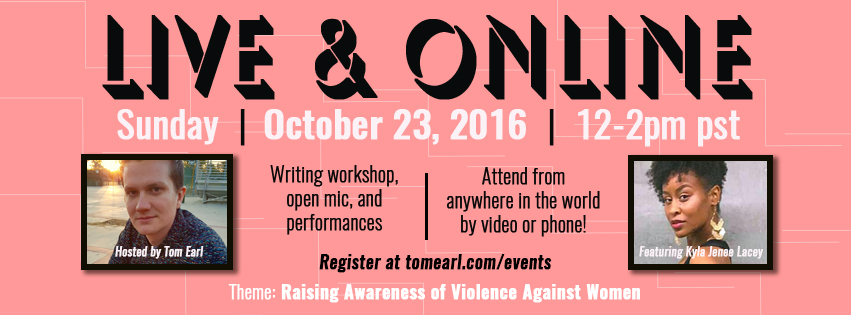
Kyla will also be the feature for this month's Live and Online Expression Session.  That will take place on October 23rd at 12 PM PST - 2 PM PST.  

To listen:

It is also available as an iTunes podcast.