T.H.E. Celebration With Special Guest: Terna

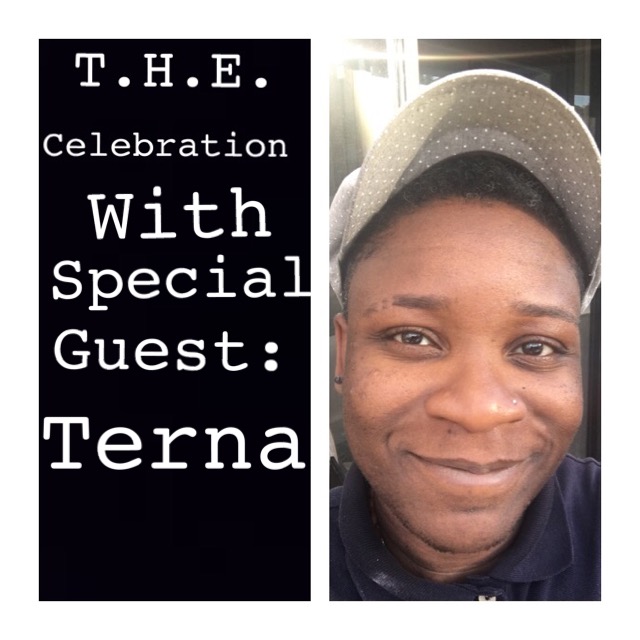
This week, I had the pleasure to host a phenomenal and in depth interview with the amazing Terna, of (among many things) Coming Out Muslim. We had a deep dialogue with all about her insights and relationships with education, Islam, sexuality, health, healing, and self-care!

Terna is a Nigerian/ Liberian/American artist, facilitator and healer. She holds an MA in Counseling Psychology and Global Mental Health, and graduate degrees in International Conflict Analysis and Teaching.  She has worked as a public school teacher in New York, at the United Nations, and currently works to help survivors of homicide and victims of community violence.

Terna is also the co-writer of Coming Out Muslim: Radical Acts of Love,  which captures stories and experiences of being at the intersections of Islam and queerness and its relationship to family, lovers, one’s sense of self and relationship with our faith.

Get ready to be absolutely enthralled!

This interview is always available as a podcast!

Prefer to listen on iTunes?

Listening to Your Inner Voice


The answers that we seek are already within us.  All of the resources, the resourcefulness, the energy, and the time that you need to accomplish everything within your purpose is right there, already within you.

This understanding allows us to recognize the true potential we have within.  Along with this mindset, there are applicable and practical tools that you allow us to tap into the answers within.

One of the greatest assets and important skills to develop is listening to our inner voice.  A key to unlock that, is developing the questions we are asking.

Your free gift for this episode is the "Unlock Your Inner Voice Reflection Guide." 

Want to take a deeper dive? Check out this week's podcast!

Prefer to listen on iTunes?

Music Playlist: Suggested Best Of Erykah Badu

I posted on Facebook : What's your favorite Badu song? And you all delivered! The result was a collection of past and more current songs from this wonderful soul artist. The range of emotions from song to song is also so beautiful! Hope ya'll enjoy!!

In no particular order: 

  1. Other Side Of The Game
  2. Orange Moon
  3. Out My Mind, Just In Time
  4. Tyrone
  5. Green Eyes
  6. On and On
  7. Sometimes
  8. I Want You
  9. Love Of My Life
  10. You Got Me
  11. Window Seat
  12. Didn't Cha Know
  13. In Love With You
  14. Next Lifetime
  15. No Love

Listen to the playlist on Spotify or Youtube:

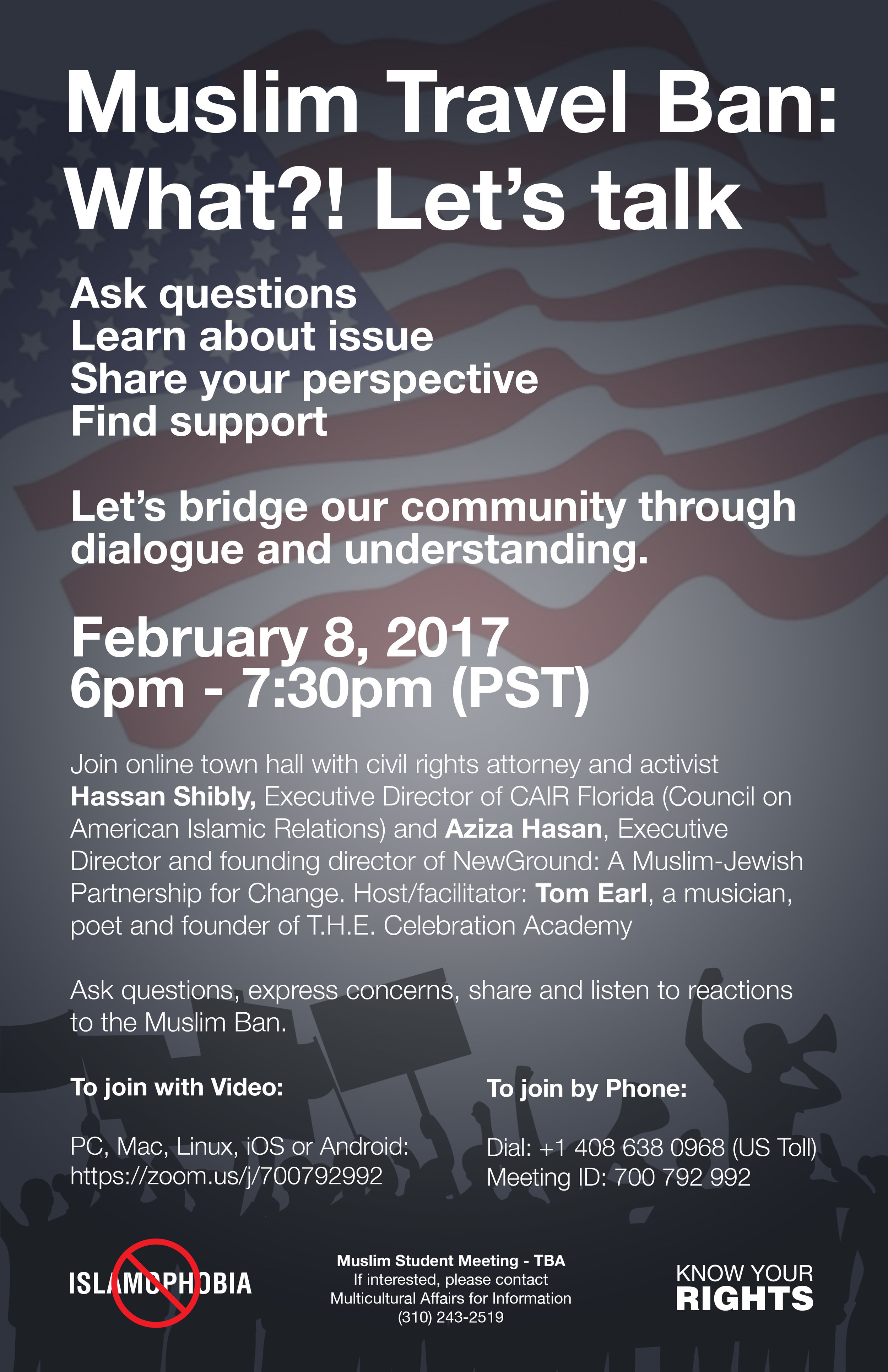
Town Hall Dialogue on #MuslimBan, #TravelBan, #KnowYouRights

This is a replay of the Live and Online Town Hall Dialogue that took place on February 8th, 2017. The program was sponsored by the California State University, Dominguez Hills Multicultural Affairs. 

Panelists: 
Hassan Shibly is a civil rights attorney, activist, and Executive Director of CAIR Florida. Contact: facebook.com/hshibly or www.cairflorida.org.

Aziza Hasan: Is the Executive Director of NewGround: A Muslim-Jewish Partnership for Change. Contact: www.mjnewground.org.

Host: 
Tom Earl: Musician & Poet, CEO of Tom Earl Artist and Founder of T.H.E. Celebration Academy. 

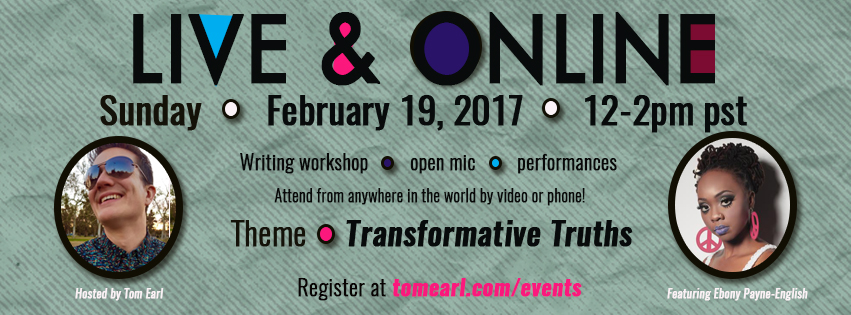
Live and Online: Expression Session - February Edition (Featuring Ebony Payne-English)

Live and Online: Expression Session is a monthly writing workshop which culminates in a featured performance by an international recognized artist.  This month we are blessed to have Ebony Payne-English as our feature!

Click here to register!

In anticipation of the event, Ebony joined me for an interview.  She shared her writing journey, what motivates her, and performs 3 poems. 

For your free give-away for this episode, Ebony shared with us 3 of her favorite writing prompts.  To download it, click here or below.

Here's the interview:

You can also listen to the interview as a podcast below or on iTunes.

Adele, White Privilege and The Grammys

Adele gets to transcend genre because she is white. It is because of white privilege that white artists are able to be individuals, moving beyond categorization.  Our privilege allows us to be just us, rather than seen in comparison to the social groups we belong to.  It is no different than any other profession.  Often times, we are rewarded for work that is really mediocre - our privilege gives us that extra bump up.

adele.jpg

I think Adele is a genius.  I love her music.  I have rolled up my windows and driven along passionately singing the chorus to hello many a-time.  So this isn’t a knock on Adele. It is an acknowledgement that Adele, and all white artists such as myself, benefit from white privilege in all aspects of our careers.

Our biases affect how we perceive an artist and their work.  As soon as we find out the gender, or race, or sexual orientation, or body type, and all the other aspects of their identity, our minds immediately place them into the boxes our collective and personal biases have created.  For most people, this process happens without our realization, or even permission, and is formed through our subconscious and implicit biases.

If Adele was a Black or Brown Women, perceptions of her, and her music, and the words used to describe her and her music, would be completely different.  Her entire experience of becoming a rising star would have been different.  And it is hard to imagine that she would have received the amount of awards she has this far.  Rather than being a star in her own category, she would constantly be compared to other Black or Brown Women who vaguely sound and/or look like her.

Let’s check the stats: only 10 black artists have won Album of the Year in Grammy history: Stevie Wonder, Ray Charles, Lauryn Hill, Michael Jackson, Natalie Cole, Lionel Richie,  Outkast, Whitney Houston, Herbie Hancock  and Quincy Jones.

We all remember Macklemore’s Grammy night.  Macklemore has won more rap grammy awards than  “2Pac, Biggie, Nas, DMX, Busta Rhymes, KRS-One, Rick Ross, Snoop Dogg, Mos Def, Run DMC, Public Enemy, Big Pun, Jeezy, Ja Rule and Kendrick Lamar, combined” (Complex, 2015).

I’m not saying Mack is terrible either, I’ve enjoyed his music often. But I know, you know, he knows, we all know, he is not better than all of those rappers combined.   That’s the bump white privilege gets you.

Of course, Adele’s wins were in stark contrast with Beyonce not winning.   Adele even gave a great speech acknowledging how messed up (racist) the Grammy process is. Lemonade was a cultural, musical, and cinematic work of genius.  You don’t need me to talk about how powerful, empowering, revolutionary and impactful Lemonade is.  That much is obvious.  Lemonade was also Black.  Beautifully Black.  Brilliantly Black. Boldly Black. Black Girl Magic Black.  

But white supremacy does not recognize Black.  White supremacy denies Black, while claiming all lives matter.

The Grammy’s won’t reward that.  The Grammy’s are just another night of white privilege at play.

My privilege is everything.

If I avoid the news, social media, and conversations with friends, I can go for long periods of time without ever having to think about my race, gender, or any other aspect of my social identity. When I'm walking in the street, or driving, or going to the store, I don't have to think about how someone might perceive my race, my gender, my sexual orientation, or my age. I can remain as oblivious as I want.

Even when I try to be intentional and reflect on how my identity impacts my interactions and access to power and privilege, I am still relatively unaware. I read about it, I hear about it, I have seen it first hand, but in an every day way, I don't have to think about it. I can think about other things. I can spend that energy on whatever else I want.  My privilege gives me that choice.

My Muslim identity does not fit into that category. But I am able to pass. People don't look at me and think, "That's a Muslim."  I only experience that when it is made known or I say something about it. Of course, the constant Islamophobia in the news and political climate means the segmentation of Muslims is constantly on my mind.  But like I said, if I want to, I can turn that all off.  Tune out.  Pretend its not there.  Since I pass, I can walk around, or hop on a plane, or move through society without being forced to think, what does this person think about Islam, and me, and the fact that I'm Muslim?

This privilege I’m afforded means that for the most part I get to be an individual.  I get to buy into the belief of meritocracy.  That my journey of success is solely based on my ability to work hard, utilize my intelligence, and do my thing.  I am able to go through my life thinking, I am an individual and my success or failure rests upon my shoulders.

And so as I achieve more and reach new heights of success I feel great about myself. Look at what I achieved.  I worked hard at this.  I grinded, and worked 80 hour weeks, nights, weekends, I sacrificed, and scraped by, and I am proud of what I have and what I’ve done.

Then there are those times where on the news, or on social media, or on my way home from work, I’m forced to think about my identity and how it fits into our institutions of power and oppression.  And what I see and hear is that I have privilege.  That I didn’t earn everything I have just based upon my own hard work.  That I have been given an advantage in everything I’ve ever done. From renting my apartment, to driving my car, to the way my teachers treated me, to getting hired, to buying food at the grocery store.  It means, even if I grew up poor and had nothing, I still had/have white privilege.  In all of these areas, I had and will continue to have an almost invisible but significant advantage.

There are some forks in the road at this point.  I can get pissed off and say, “That’s not true. No Way.  You don’t know anything about my life.”   Which is completely true.   Discrimination as a system means that the person is no longer an individual.  They are brutally forced into a box built by stereotypes and prejudice.  It is complete garbage.  The reality is when there is systemic discrimination, then there is also systemic privilege.  And we as white people, as men, as thin people, as straight people, as cis people, we have systemic privilege.  And if you are like me, we are privileged in every single one of those areas.

And so, back to the fork in the road.  I could get pissed off and project that onto the world, saying you are wrong. This isn’t right.  You don’t get it. I’m canceling my Netflix subscription.  That is one choice.

The other option is that if I’m pissed off about being privileged than I could work to end systemic oppression and the institutions that give me privilege. If I really want meritocracy, the only way that will ever be, is to end discrimination. 

That isn’t my primary driving force for wanting to create a world free from discrimination.  But if one is pissed off about being privileged, channel that rage into ending white supremacist capitalist patriarchy (bell hooks).  All other avenues are wasted energy.

In the many conversations I’ve had on privilege, I’ve found that we only get upset about our privilege when it is called out and put on the table.  We weren’t upset when we got the benefit of the doubt during the hiring process, or routine traffic stop, or applying for a loan, or when we see ourselves positively represented in the majority of media and movies. I never hear white people or men or straight people say, “Hold on a second here! I want to earn this solely based on merit. Are you sure you aren’t hiring me because I’m white? Are you sure I’m not getting paid more because I’m a man?  Am I keeping my job when I talk about my partner at work because I’m straight?”  No.  The, “hold on a second,” only arises when we have to face the fact that we didn’t earn it all based on merit or our hard work.  It was also because of our privilege.

This is usually the part where folks let me know how their individual experience differs from the generalized picture I’ve painted.  Which demonstrates how difficult it is for those of us with privilege to conceptualize what it means to have our identities forced into a generalized box.  Our individual experience does not disprove white privilege or male privilege or any other privilege.  Systemic oppression subtracts the individual personal experience and places you at the full mercy of generalization and stereotype.   This is the same for the other side of the equation, systemic privilege means that, even if I had to work super hard, even if I now live in another country and people are mean to me, even if at school people called me cracker - all of that is a part of your story. But it is not the white story or the male story, because the privilege we experience as a group tips the scales so much in our favor that whatever experiences we’ve had would have left us with fewer viable options than if we had not been in our privileged group.

Our election has demonstrated that for many of us racism and sexism are not deal breakers.  From the conversations that arise, we continue to articulate that we believe it is worse to be called a racist, than it is to experience racism (or any other type of ism).   But here is my promise: these conversations are not going to stop or go away.  The fact that we are able to go so long without having them is because of our privilege.  Which is where this whole thing began.

As those of use who experience privilege in many or in some aspects of our identity, one exercise is continually helpful to reflect upon: my actions, my questions, my arguments, my conversations – are they upholding systems of oppression and power or working towards transformation and equity?  Asking ourselves these types of question will ground us in reality and provide self-awareness.

Thank you for taking the time read this and perhaps allowing some of the ideas I’ve brought up to percolate. I’d like to conclude with some good ol’ fashioned Brene Brown and bell hooks wisdom. 

Brene says, “we need to engage our emotions, and get curious about the story behind them.” What are you feeling at this moment? Check in with your emotions and name them out loud. What is the story behind those emotions? 

Lastly, one of my big ‘ahas’ was in bell hooks’ conversation on how self-awareness is intrinsically linked to personal responsibility.  We do not take responsibility for what we are not aware of.  And yet, we are held and will be held accountable for it whether we have awareness or not.    Therefore, it is better to know - to be aware of our privilege, to own it.  Realize the ways I am using my privilege to uphold oppression, and change those actions and mindsets. Rather than remaining oblivious, I can make the decision to become engaged and take action. 
Taking Time to Just Dream

How often do you take time to just dream? When do you sit in stillness and envision? When have you written down, “If I had the chance to live my life exactly as I wanted to starting today, what would it look like?”

We often get into the day to day routine, without stopping to reflect and ask ourselves these big picture questions. Our life is ours to control and is a result of our decisions .  One of the most important ones we can make is deciding to set aside intentional time to reflect.

It may feel like work at first or that you don’t have the time.  But my reward is worth the work :).   

I'm inviting you to once a week, create an opportunity for reflection.  It could be going for a walk, journaling, coloring, meditating, whatever you’d like.  You’ll find that you start making bold moves by infusing your week vision and reflection.

This week's free giveaway: Dream Big Prompts.

Want to take a deeper dive? Listen to the the podcast that accompanies this episode.

You can listen to it on iTunes as well. 

If you would like to work on this together, enroll in T.H.E. Celebration Academy.  You can start with our free mini-course T.H.E. Achievement Roadmap. 

Special Guest Hassan Shibly - #TravelBan, Know Your Rights, and Islam

Special Guest Hassan Shibly - #TravelBan, Know Your Rights, and Islam

Hassan Shibly is a civil rights attorney and Executive Director of CAIR Florida.  On this episode Hassan answers questions and offers his expertise on the #TravelBan, #MuslimBan,  Debunks Islamophobia Myths, and covers Know Your Rights 101 especially when protesting and while traveling.

T.H.E Celebration With Special Guest: Leah Williams

This week we have special guest: Leah Williams, joining us at T.H.E. Celebration.  Leah is a Spelman College Graduate with a B.A. in Economics, a passionate advocate for social justice, and a powerful role model of inclusive leadership.   

I first met Leah while I was serving as an AmeriCorps VISTA at Community Tampa Bay.  She was the president of the youth leadership program (F.L.Y.) that I was facilitating.  The last time Leah and I spoke she was just graduating High School!  Not only did I enjoy catching up, but I also learned a lot from Leah’s insights and the stories she shares during this interview.  

You will walk away feeling inspired and empowered!   

Bonus: Click here for this episodes FREE give-away! The List of Leah’s Top 5 Favorite Books. 

This episode is also available as a podcast:

Prefer to listen on iTunes?